Do Different Tarot Decks Have Different Meanings?
Yes. Different tarot decks have different meanings, and anyone who tells you a card means the same thing in every deck has only ever owned one.
The bones are shared. Nearly every tarot deck has seventy-eight cards, the same four suits and the same twenty-two trumps. But you do not read bones. You read the picture in front of you, and the picture changes from deck to deck, sometimes a little and sometimes entirely. That is the whole difference between tarot cards, and it is why choosing a deck matters more than memorising a list.
Let me show you.
What every tarot deck has in common
Seventy-eight cards, in two parts.
- The Major Arcana: twenty-two trumps, from the Fool to the World. These are the ones people who have never held a deck can still name. Death. The Tower. The Lovers.
- The Minor Arcana: fifty-six cards in four suits, each running ace to ten with four court cards. Wands, Cups, Swords and Pentacles, in the commonest naming.
If that second part sounds familiar, it should. Take away the trumps and one court card per suit and you are holding an ordinary pack of playing cards. Wands are clubs, cups are hearts, swords are spades, pentacles are diamonds. Tarot began as a card game in northern Italy in the 1400s, and nobody told fortunes with it for another three hundred years. The cards remember where they came from, even if the books forget.
The three families
Almost every deck you will meet descends from one of three. Know the three and you can find your feet in any of them.
Rider-Waite-Smith (1909)
The one you have seen. Arthur Waite gave the instructions, Pamela Colman Smith did the drawing, and it is Smith you should thank, because she did something that changed everything: she gave every one of the small cards a scene. The Three of Swords is a heart run through in the rain. The Ten of Wands is a man bent double under a load he chose to carry. You do not need a book to feel what those mean.
Most modern decks are this deck in different clothes. If a meaning is quoted to you as “the” meaning, it is very likely Smith’s picture, described.
Tarot de Marseille (1600s onward)
The old French pattern, and a different animal. The trumps are woodcuts, bold and flat. The small cards have no scenes at all: the Seven of Cups is seven cups, arranged. To read them you work from number and suit, the way you would with playing cards, and the deck gives you nothing for free. People who love it love it for exactly that. It is quieter, and it does not tell you what to think.
Thoth (painted 1938–43)
Aleister Crowley’s deck, painted by Lady Frieda Harris over five years and not published until both were dead. It is beautiful and it is dense: astrology, Kabbalah and Crowley’s own system are packed into every card, and each small card carries a title printed on it. The Seven of Cups says Debauch. Not much room for doubt there.
It also renames things. Strength becomes Lust. Temperance becomes Art. Justice becomes Adjustment. The court is Knight, Queen, Prince and Princess, with no King at all. If you learn on Thoth and then pick up a Waite-Smith deck, you will spend a week looking for people who are not there.
Where the same card stops being the same card
Here is the proof, since you ought not to take my word.
Trump eight and trump eleven. In the Marseille deck, Justice is eight and Strength is eleven. Waite swapped them, to suit his astrology. Crowley swapped them back. So “card eight” is three different cards depending on whose deck is on the table, and any book that gives meanings by number alone will lead you wrong in two decks out of three.
The Seven of Cups. In Marseille: seven cups, read by number. In Waite-Smith: a figure dazzled by seven visions floating in cloud, which is wishful thinking and too many choices. In Thoth: seven cups dripping green slime under the word Debauch. The same card, in name. I would not give the same reading from any two of them, and neither should you.
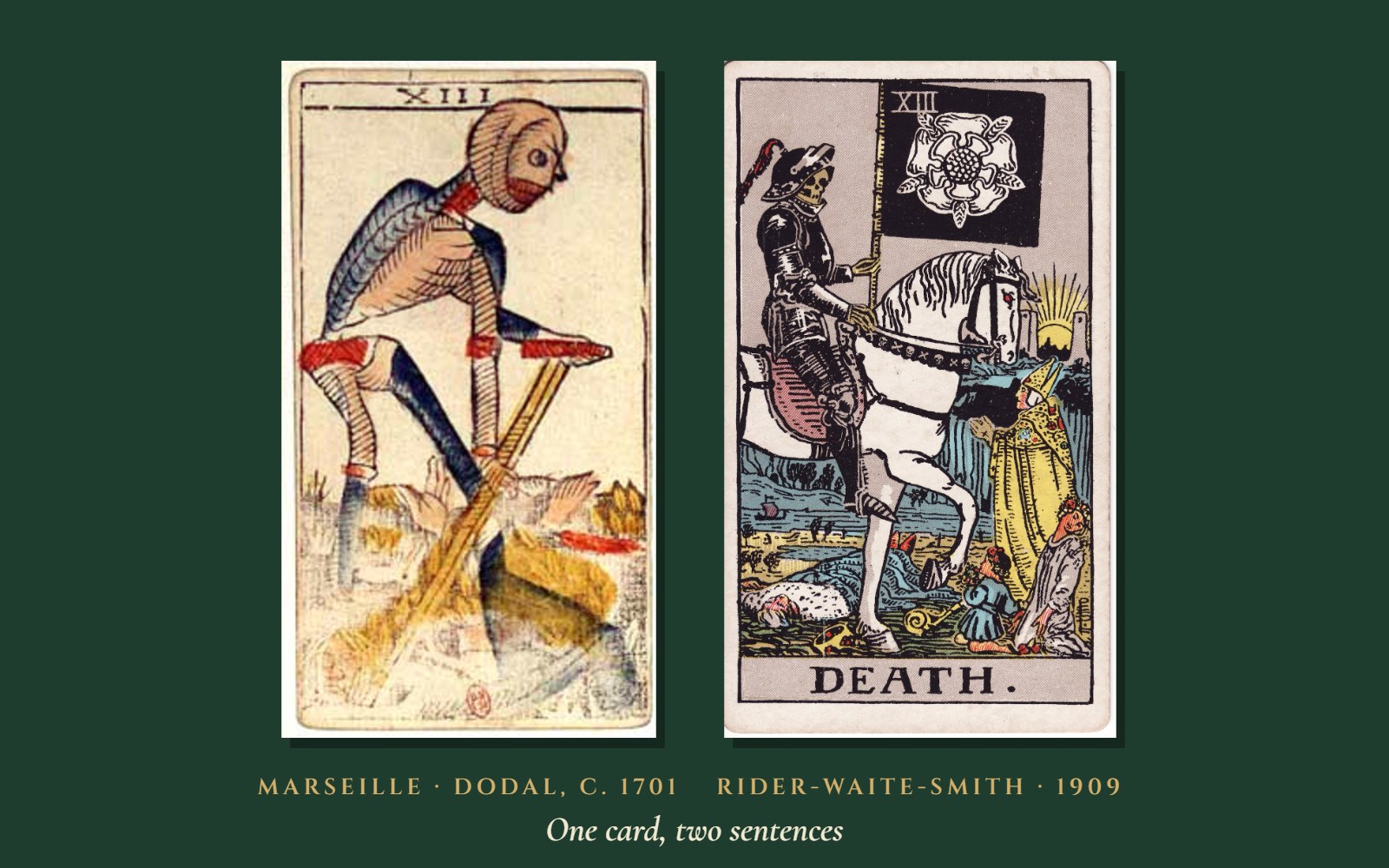
Death. In Marseille the card often has no title at all, only the number thirteen and a skeleton with a scythe, mowing a field of heads and hands. Waite-Smith puts him on a white horse with a bishop pleading at the stirrup and the sun rising behind. One is a harvest. The other is a procession with a dawn in it. They are not the same sentence.
The suits themselves. Pentacles are Coins in Marseille and Disks in Thoth. Wands may be Batons, Staves or Rods. Some decks give Wands to fire and Swords to air; a stubborn few do it the other way about. Check before you assume.
So how do you read a deck you have never met?
Look at the card. That is very nearly the whole of it.
The little white book that comes in the box is somebody’s summary of somebody else’s summary. It will do for a week. After that, put it in a drawer and look at what the artist actually drew: who is in the picture, which way they face, what they are holding, what the sky is doing. If the deck’s Five of Pentacles shows two beggars passing a lit church window, that is a card about help close by and unseen. If another deck’s Five shows five coins and nothing else, you are back to number and suit, and you had better know what fives do.
A deck is a language. You would not read Italian out of a Spanish dictionary just because the words look alike. (You would get by. You would also, sooner or later, order something you did not want.)
How to choose a deck
Choose the one you keep looking at. I mean that as practical advice. You will be staring at these seventy-eight pictures for years, and a deck that leaves you cold will stay in its box no matter how correct it is.
A few firm opinions, since you came here for them:
- Start with a scenic deck, Waite-Smith or one of its many children, unless Marseille’s plainness is exactly what draws you. Pictures teach faster than titles.
- Leave Thoth for your second deck. It is magnificent, and it wants a year of your attention to itself.
- Buy your own. You will hear that a first deck must be given to you or it will not work. That is a pretty superstition, and it has kept a good many people waiting for a present that never came. Buy the deck.
- Look at the small cards before you pay. Anyone can paint a handsome Tower. The Six of Wands is where you find out whether the artist was still trying.
- One deck at a time. Learn one language properly before you start collecting dictionaries. Then collect as many as you like. I am in no position to lecture anyone on that point.
And if all you have is a pack of playing cards?
Then you have fifty-two of the seventy-eight already, and people were reading fortunes from plain playing cards long before they thought to use tarot for it. Hearts for cups, clubs for wands, spades for swords, diamonds for pentacles. No trumps, so no Tower and no Fool, but the everyday business of a life is all in the small cards anyway.
The pack I reach for is the Creatures of the Fae deck, for the plain reason that its court cards are worth reading: Oberon, Titania and Puck in the red suits, Queen Mab and the Erlking in the black. A queen of spades who is Mab herself gives you rather more to work with than a queen of spades who is nobody.
Full disclosure: The Everyday Fae has a connection to the makers of the Creatures of the Fae deck.
Keep reading
- Lady Elppy, who kept this blog before me, wrote about her own decks and how she chose them: The Difference Between Tarot Cards and Why it Matters. If you are choosing your first, read hers too.
- The Faery Star: What the Seven-Pointed Star Means
- The Seelie and Unseelie Courts, Explained
Sources and further reading
- Michael Dummett, The Game of Tarot (1980), on tarot’s origin as a fifteenth-century Italian card game.
- Ronald Decker, Thierry Depaulis and Michael Dummett, A Wicked Pack of Cards: The Origins of the Occult Tarot (1996).
- A. E. Waite, The Pictorial Key to the Tarot (1910), illustrated by Pamela Colman Smith.
- Aleister Crowley, The Book of Thoth (1944).
- Stuart R. Kaplan, The Encyclopedia of Tarot, vol. 1 (1978), for the Marseille pattern and its makers.