The Faery Star: What the Seven-Pointed Star Means (and Why It’s on Our Box)
If you spend any time around faery lore, you will eventually meet a seven-pointed star. It turns up on pendants and altar cloths, on the covers of books about the fae, and, in a knotted Celtic form, on the box of the Creatures of the Fae deck whose star also serves as this site’s icon. People call it the faery star, the fairy star, the elven star, or, if they are being precise, a heptagram or septagram.
It is a lovely symbol with a tangled history. Here is what it is, what people say the seven points mean, and the honest answer to the question I get asked most: does it have any connotations I should worry about?
What the faery star actually is
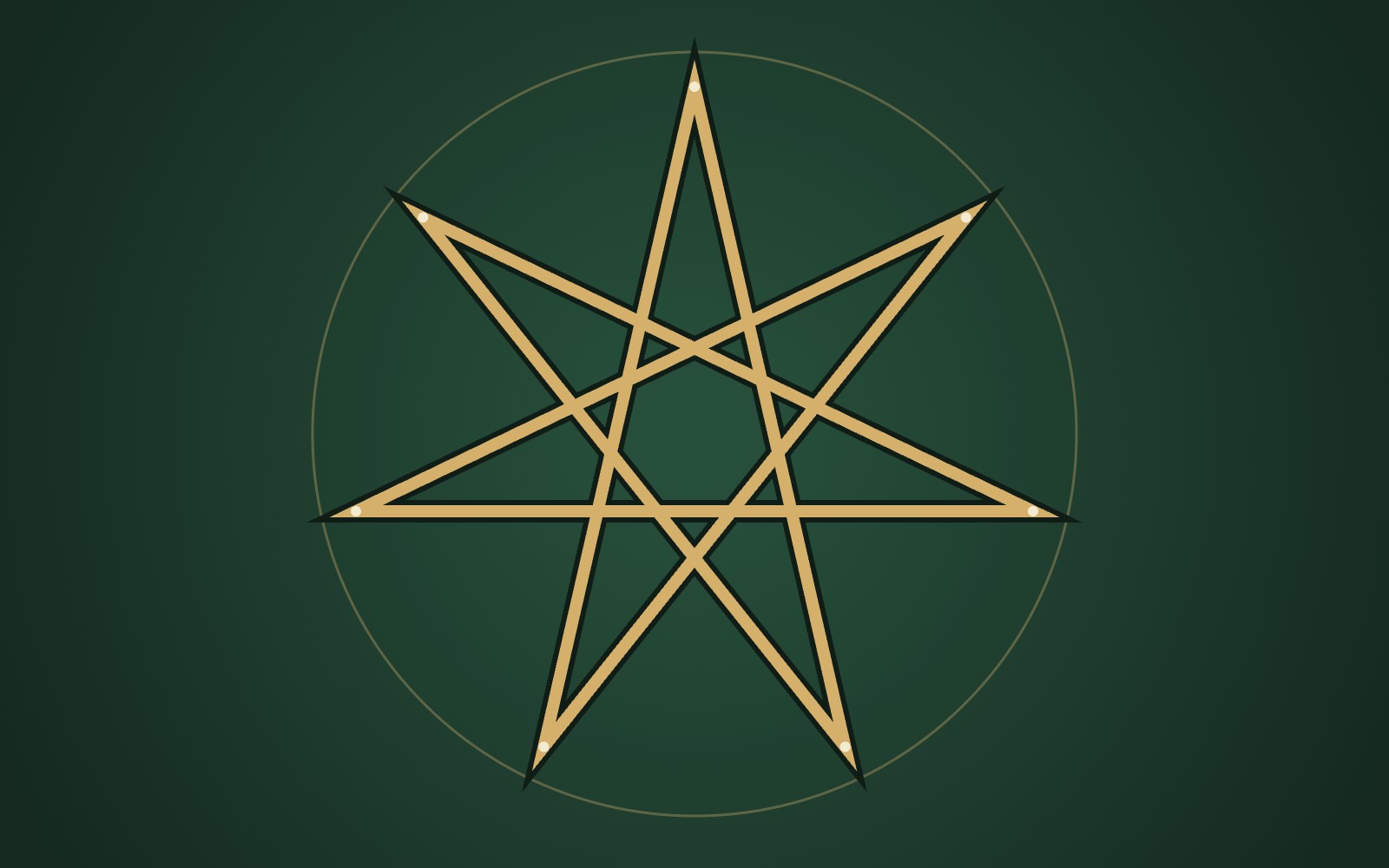
Geometrically it is a heptagram, a seven-pointed star drawn in a single unbroken line. There are two ways to do that. If you connect every second point you get a fat, open star (written {7/2}). If you connect every third point you get a sharper, more elongated one ({7/3}). The faery star is almost always the second kind, the sharp one, though you will see both.
That unbroken line matters to the people who use it. Like the pentagram, it can be traced without lifting the pen, which has long made it a symbol of continuity and of things that return to their beginning.
Seven is also simply a number with a very long resume. Seven classical planets, seven days, seven metals of the alchemists, seven notes in the scale, seven colours in the rainbow, the seven sisters of the Pleiades. Any seven-pointed figure inherits all of that whether it wants to or not.
Where it comes from
Nobody can point to the day the heptagram became a faery symbol, and anyone who tells you otherwise is guessing. What we can say is roughly this.
The seven-pointed star has a long life in Western esoteric tradition well before anyone attached faeries to it. Medieval and Renaissance alchemists used it to arrange the seven metals and their planets. In Hermetic Qabalah the septagram is tied to Netzach, the sphere of Venus, and to planetary magic generally. Aleister Crowley made a seven-pointed star the seal of Babalon in Thelema in the early twentieth century. None of this is about the fae; it is about sevens.
The specifically faery use seems to be a late twentieth-century development. It grew up in the overlap between modern Pagan traditions that work with the fae, the loose community of people who identify with elves and faeries, and the fantasy art of the 1970s and 80s. By the 1990s the “elven star” was established enough to be sold as jewellery with that name, and by the 2000s it had largely detached from its occult ancestry in most people’s minds. Emily Carding’s book Faery Craft (2012) built an entire practice around the star’s seven points, and did more than anything else to give it a settled meaning in the faery context.
So: ancient geometry, medieval symbolism, modern meaning. That is a perfectly respectable pedigree. It is the same path the pentagram took.
What the seven points mean
This is where you have to accept that there is no single official answer. The two sets of meanings you will meet most often are these.
The seven directions. North, South, East, West, Above, Below and Within. This takes the four quarters familiar from most Western ritual, adds the sky and the earth, and finishes with the centre, the self standing in the middle of it all. I like this one because it is a map rather than a list of virtues. It says: here is where you are, in every direction at once.
The seven realms or gifts. A popular modern set names them Sun, Wood, Sea, Magic, Moon, Wind and Spirit (sometimes Connection). You will see variations, with Stone or Earth swapped in, or the last point given as Faerie itself. The idea is that each point is a doorway into one part of the natural and otherworldly landscape the fae inhabit.
Other people assign the seven planets, the seven chakras, or the seven days. All of these are modern overlays on an old shape, and none is wrong. If you use the star, use the set that means something to you and don’t let anyone tell you the other six are heresy.
Seven-pointed stars that have nothing to do with faeries
It is worth knowing these, because you will see the same shape in places that would be surprised to learn they were faery symbols.
- The Commonwealth Star on the Australian flag has seven points, one for each of the six states and one for the territories.
- The flag of Jordan carries a seven-pointed star for the seven verses of the opening chapter of the Qur’an.
- The seal of the Cherokee Nation has a seven-pointed star for the seven clans.
- Many American sheriffs’ badges are seven-pointed, for no mystical reason anyone can document.
The heptagram, in other words, is public property. It belongs to astronomers, flag makers and police departments as much as to anyone with an altar.
Does the faery star have bad connotations?
This is the question I was asked when we were choosing a mark for this site, and it deserves a straight answer.
The faery star is not a pentagram, and it is not an inverted anything. It has no history in Satanism, which has never had much use for sevens. The only association that gives some people pause is the Thelemic one, Crowley’s Seal of Babalon, and that is a different star in a different context, usually drawn with a specific name inside it. In practice, the overwhelming majority of people who wear or use a seven-pointed star today mean one of three things by it: a love of faery lore and fantasy, a nature-centred spirituality, or simply that they liked the shape.
If you are nervous about how it reads, the knotted Celtic form, with the lines woven over and under each other, places it firmly in the decorative tradition of the insular manuscripts and takes it even further from the occult diagrams. That is the version on the deck, and it is the version I chose for the site icon.
Why it is on our box, and on this site
The Creatures of the Fae tuck box carries a knotted seven-point star, a small door in gold on a dark ground. It was the first thing I noticed about the box and it is still my favourite detail of the whole design. When this site needed a mark of its own, I pulled that star out, set it in a plain gold ring, and have used it ever since.
So if you see the star in your browser tab while you read this, that is all it means: the fae, the seven directions, and a deck of cards I’m fond of.
Full disclosure: The Everyday Fae has a connection to the makers of the Creatures of the Fae deck.
Keep reading
Sources and further reading
- Emily Carding, Faery Craft: Weaving Connections with the Enchanted Realm (Llewellyn, 2012).
- “The Faery Star: Magick and Meaning”, Grove and Grotto, on the symbol’s esoteric background and modern uses.
- Katharine Briggs, A Dictionary of Fairies (1976), for the folklore the modern star draws on.
- On the heptagram in alchemy and Qabalah: Israel Regardie, The Golden Dawn (1937–40).