The Erlking: The Elf-King Born of a Mistranslation
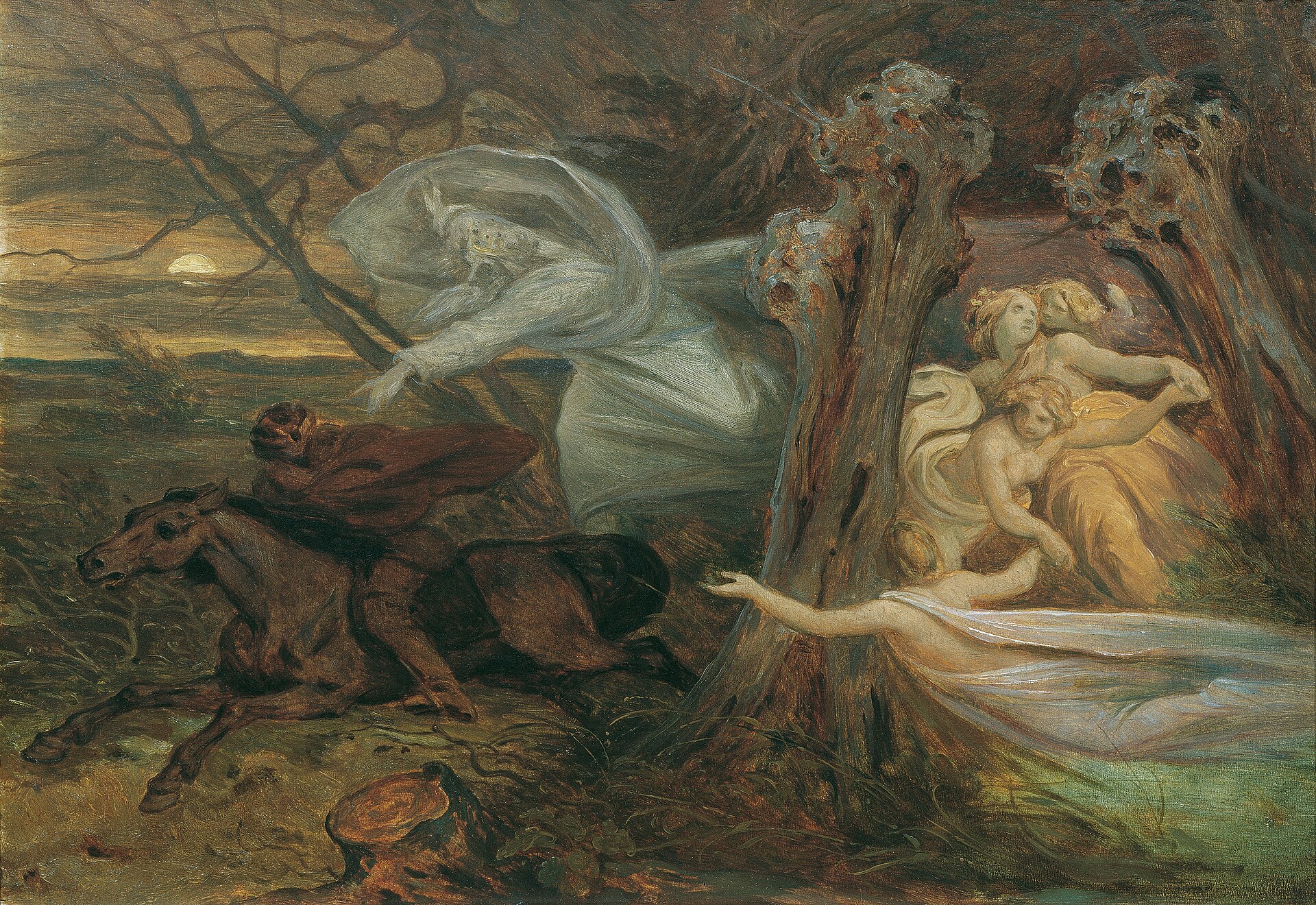
A father rides through the night with his sick son in his arms. The boy hears a voice in the wind, whispering promises: golden robes, flowers on the shore, daughters who will dance him to sleep. The father hears only rustling leaves. Then the voice turns. “I love you, your beauty delights me; and if you’re not willing, I’ll take you by force.” When the father reaches the farmhouse, the child in his arms is dead.
That is Goethe’s “Der Erlkönig” (1782), and it is the whole reason the Erlking is the King of Spades and the head of the Unseelie Court in the Creatures of the Fae deck. No other faery figure has a death scene that good.
A king born of a mistranslation
The Erlking’s name is an accident, and a famous one. In 1778 the German philosopher Johann Gottfried Herder published a translation of a Danish ballad, “Elveskud”, in which the elf-king’s daughter tries to lure a young knight, Sir Oluf, to dance with her on the eve of his wedding. He refuses; she strikes him, and he rides home and dies, and his bride dies of grief at the sight of him. The Danish word was ellerkonge, a form of elverkonge, elf-king. Herder rendered it Erlkönig, alder-king, apparently taking the first element for the alder tree.
Whether that was a slip or a choice, it produced a creature that had not existed before: a king who lives in the alders by the water, who belongs to the mist and the marsh rather than to the hill. Goethe took the name from Herder, dropped the daughter into the background, and wrote his poem four years later for a short musical play, Die Fischerin. The poem opens the play, sung by a girl mending nets, and it is one of the most set-to-music texts in the language. Schubert’s version (1815), with its galloping piano and four voices in one throat, is the one most people know. Carl Loewe’s, written independently in 1818, is quieter and in some ways more frightening.
What the Erlking is
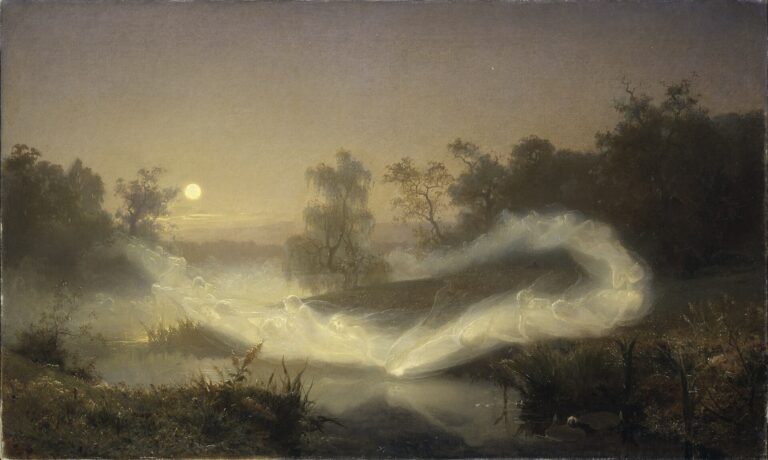
Strip away the music and you have a very old kind of faery. The elf-kings and elf-maidens of Scandinavian ballad are beautiful, seductive and lethal. They dance on the hillsides in the twilight and invite passing humans to join them, and the humans who refuse are struck with sickness, which is where the Danish title comes from: Elveskud, elf-shot. The humans who accept are not seen again. They want human lovers and human children, and they do not take no for an answer.
That makes the Erlking a close cousin of the fairy kings and queens of Britain who carry off Tam Lin and Thomas the Rhymer, and of the Irish and Scottish fae who take children and leave changelings. Goethe’s innovation was to make the victim a child, and to make the abduction a seduction. Every reader has to decide whether the Erlking is really there or whether the boy is dying of fever and the father is riding through his delirium. Goethe does not say. The ambiguity is the horror.
The Erlking in English
He crossed into English early. Walter Scott translated Goethe’s poem in 1797, and the Erlking has been a presence in English-language fantasy ever since, usually as the dark lord of the faeries, the counterweight to Oberon. Angela Carter wrote a story called “The Erl-King” in The Bloody Chamber (1979) that turns him into a seducer who keeps his lovers as caged birds. He has been a villain in comics and games more times than can be counted.
In the Scottish scheme of Seelie and Unseelie he is the model Unseelie monarch: not a demon, not evil in any theological sense, simply a power that wants what it wants and regards human grief as weather.
On the card

The Erlking is the King of Spades, which in most of the old card games is the suit of death and of the sword. His queen in the deck is Mab, who deals in dreams and nightmares, and his jack is Gwyn ap Nudd, the Welsh lord of the dead who leads the Wild Hunt. The Spades court is the court of the Otherworld proper, the three rulers who take people away. The Erlking sits at the head of it because he is the one who comes for you in the night and asks nicely first.
Sources and further reading
- Johann Gottfried Herder, “Erlkönigs Tochter”, in Stimmen der Völker in Liedern (1778), translating the Danish “Elveskud”.
- Johann Wolfgang von Goethe, “Der Erlkönig”, in Die Fischerin (1782).
- Franz Schubert, “Erlkönig”, D. 328 (1815); Carl Loewe, “Erlkönig”, Op. 1 No. 3 (1818).
- Walter Scott, “The Erl-King”, translation (1797).
- Angela Carter, “The Erl-King”, in The Bloody Chamber (1979).
- Katharine Briggs, A Dictionary of Fairies (1976), “Elf-shot”.
The twelve court cards
This post is one of twelve, one for each court card in the Creatures of the Fae deck. The Seelie Fae hold the red suits and the Unseelie Fae the black.
Seelie Fae
- Oberon, King of Diamonds
- Titania, Queen of Diamonds
- Puck, Jack of Diamonds
- the Brownie, King of Hearts
- the Pixie, Queen of Hearts
- the Leprechaun, Jack of Hearts
Unseelie Fae
- the Erlking, King of Spades (this post)
- Queen Mab, Queen of Spades
- Gwyn ap Nudd, Jack of Spades
- the Goblin, King of Clubs
- the Cat Sìth, Queen of Clubs
- the Red Cap, Jack of Clubs
The deck itself, with all twelve court cards, is here on Amazon.
Full disclosure: The Everyday Fae has a connection to the makers of the Creatures of the Fae deck.