Faeries of the Wheel of the Year
Think of the year as a door on its hinges. Most days it hangs quietly and nothing comes through but the draft. On a handful of nights it stands ajar, and those are the nights the Good People are abroad. Nearly every festival on the Wheel of the Year has a story about who is out that night, and a rule about what you had better leave on the step.
Lady Elppy, who kept this blog before me, has already written about the faery holidays themselves: how people mark each one and what each festival means. This is the other side of the door. Who do the old stories put at each turning of the year? Call them holiday fairies if you like. The people who told these stories called them the Good People, and kept their voices down when they did.
One word before we set out. The eight-spoked Wheel is a modern piece of joinery, fitted together in Britain in the 1950s and 60s in the circles around Gerald Gardner and Ross Nichols. The old Irish year turned on four festivals: Samhain, Imbolc, Beltane and Lughnasadh. Those four are where the faery lore runs thickest. The solstices and equinoxes have their stories too, but you will notice the difference.
Samhain (October 31): the night the mounds open
In Ireland and Scotland, Samhain was the hinge between the bright half of the year and the dark, and on that night the sídhe, the faery mounds, stood open. The host rode out. The old Scottish ballad of Tam Lin turns on exactly this. Janet wins her lover back from the Queen of Faery on Halloween night by pulling him from his horse as the procession passes Miles Cross, and holding on while he changes shape in her arms. Note that she did not argue with them. She held on.
In the Highlands they say a saucer of milk went out at Samhain for the cat sìth, the great black faery cat. A house that remembered was blessed, and a house that forgot might find its cows dry by morning. (I will not swear to how old that one is. I would put the milk out regardless.) In Wales the night before Calan Gaeaf, the first day of winter, was an ysbrydnos, a spirit night, and nobody sensible lingered by a stile, a crossroads or a churchyard after dark.
Then, the morning after, the púca takes the blackberries. Irish children were told never to pick them once Samhain had passed, because the púca had been along the hedge in the night and spat on whatever was left. That is the polite version. Taste a November blackberry and you may decide he did everyone a favor. For ways to keep the night yourself, see Lady Elppy on All Hallows’ Eve with the faeries.
Yule and the Twelve Days (December 21 to January 6): visitors in the long dark
Midwinter belongs to a different company, most of them from further north. In Norway and Denmark the nisse, a small farm spirit in grey with a red cap, expects a bowl of porridge on Christmas Eve with a pat of butter on top. Do not be clever about the butter. In the tale they still tell, someone hid it at the bottom of the bowl, and the nisse took one look and went out to the barn and killed the best cow. He found the butter afterwards and was sorry, which did the cow no good. He is a near cousin of the Scottish brownie, who also works for his keep and takes offence quickly.
Across Germany and Scandinavia the Wild Hunt rode in the twelve nights of Christmas, a storm of riders and hounds that you heard rather than saw. Wise people stayed indoors and did not look up. In Iceland the hidden folk, the huldufólk, are said to move house on New Year’s Eve, and people leave candles burning to light their way. It costs you a candle. I would call that cheap.
And the Christmas fairy? She is the youngest of this company. Britain took up the decorated tree in Queen Victoria’s time, usually with an angel on top, and the fairy doll seems to have grown out of that angel some while later. She has no old folklore of her own. I am fond of her all the same.
Imbolc (February 1): Brigid at the door
Imbolc is Brigid’s feast, and there was a Brigid before there was a saint. In the old Irish stories she is one of the Tuatha Dé Danann, the people who went into the hills when mortals took Ireland and became, in later tradition, the aos sí, the people of the mounds. On St Brigid’s Eve households left a strip of cloth, the brat Bríde, outside for her to bless as she passed. Brought in the next morning, it was kept all year against sickness.
So Imbolc is a night of blessing rather than mischief, if you are willing to count Brigid among the Good People. I am, though I would not say so to her face.
Ostara (around March 20): a quiet spoke
Here I have to be straight with you. The spring equinox has almost no faery lore of its own. It was not one of the four old festivals, and most of what is said about it now is new. If you want a faery task for the equinox, plant something. Lady Elppy’s guide to gardening for the faeries will tell you what, and by May Eve you will be glad you did.
Beltane (May 1): the other open night
If Samhain opens the dark half of the year, Beltane opens the bright half, and the faeries are every bit as busy. In Ireland May Eve was the night they came for your luck. People scattered primroses on the threshold and hung rowan over the door and the byre. On May Day itself they would not give away fire, milk or salt, because whatever left the house that day took the year’s good fortune with it, often straight into faery hands. So if a stranger knocks on May morning wanting to borrow a cup of milk, you may be as rude as you like.
In Wales, one of the oldest Arthurian tales has Gwyn ap Nudd and Gwythyr fighting for Creiddylad every May Day until Doomsday, with the lady going to whoever wins on the last one. That was Arthur’s ruling. The short nights that follow are the season for faery rings and the dancing that makes them. Walk around.
Midsummer (June 21 to St John’s Eve): the faeries’ own feast
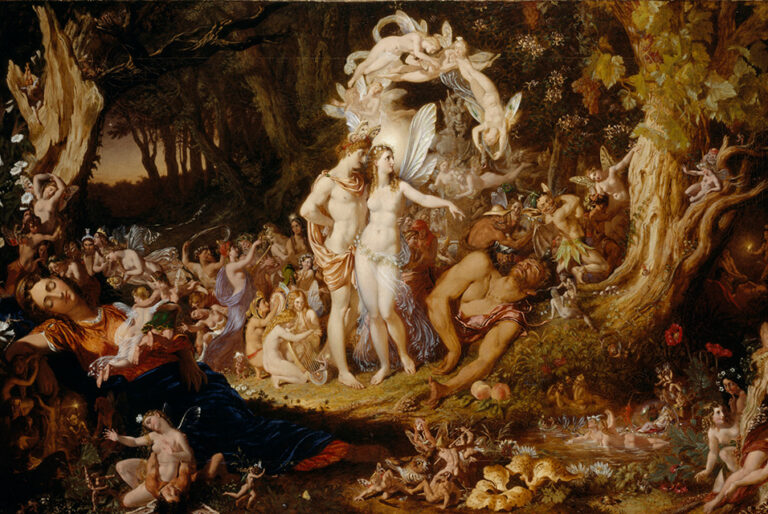
Midsummer Eve is the night most people picture when they picture faeries at all, and Shakespeare is to blame. A Midsummer Night’s Dream gives us Oberon and Titania quarrelling over a changeling boy, and Puck making a muddle of four lovers in the wood. (Read closely and the lovers seem to be out for the rites of May. Never mind. The title has done its work.) He did not invent the idea that this night belongs to the faeries. He borrowed it, as he borrowed most things.
English country people held that fern seed, gathered at midnight on Midsummer Eve, would make you invisible. Ferns have no seed, which I take to be the point. Others hung St John’s wort over the door for protection, and on St John’s Eve the bonfires burned from Ireland to Cornwall. Lady Elppy has written about a beautiful midsummer if you want to keep the feast yourself.
Lughnasadh (August 1): the first harvest
Lughnasadh takes its name from Lugh, another of the Tuatha Dé Danann, who in legend founded its games in memory of his foster mother Tailtiu. It was a time of fairs and races, and of climbing the hills to pick the first bilberries. The faeries keep to the background here, but look at who is hosting. These are the same Tuatha Dé who went under the hills. Lady Elppy’s post on Lammas, the first harvest has ways to mark it.
Mabon (around September 22): the newest name on the wheel
The autumn equinox carries a name you will not find in any old calendar. It was chosen in 1974 by the American writer Aidan Kelly, who borrowed it from a Welsh figure, Mabon ap Modron, the son of the mother, stolen from her side when he was three nights old. It is a good name. It is just not an old one.
What is old is the harvest home, and the last sheaf, cut with ceremony and kept through the winter. Lady Elppy has written on honoring the faeries at Mabon. Then the wheel turns, the nights draw in, and on the last night of October the mounds open again. You have a few weeks. Buy milk.
The faery year at a glance
| Festival | Date | Who is about | The old custom |
|---|---|---|---|
| Samhain | October 31 | The faery host, the cat sìth, the púca | Leave out milk; leave the blackberries alone |
| Yule and the Twelve Days | December 21 to January 6 | The nisse, the Wild Hunt, the hidden folk | Butter on top of the porridge; a candle left burning |
| Imbolc | February 1 | Brigid | A cloth left outside for her blessing |
| Ostara | About March 20 | Very few | Plant something for the faeries |
| Beltane | May 1 | Faeries after your luck; Gwyn ap Nudd | Primroses on the step, rowan over the door, give nothing away |
| Midsummer | June 21 to 23 | Oberon, Titania, Puck | Fern seed at midnight, if you dare |
| Lughnasadh | August 1 | The Tuatha Dé Danann | Climb a hill and pick the first berries |
| Mabon | About September 22 | Quiet, until the harvest is in | Keep the last sheaf |
Several of the faeries in this post are court cards in the Creatures of the Fae deck:
- Gwyn ap Nudd, Jack of Spades (Beltane)
- the Cat Sìth, Queen of Clubs (Samhain)
- Oberon, King of Diamonds (Midsummer)
- Titania, Queen of Diamonds (Midsummer)
- Puck, Jack of Diamonds (Midsummer)
- the Brownie, King of Hearts (cousin to the Yule nisse)
The deck itself, with all twelve court cards, is here on Amazon.
Full disclosure: The Everyday Fae has a connection to the makers of the Creatures of the Fae deck.
Sources and further reading
- “Tam Lin”, Child Ballad 39, in Francis James Child, The English and Scottish Popular Ballads (1882 to 1898).
- Culhwch and Olwen, in The Mabinogion, for Gwyn ap Nudd and Gwythyr’s May Day battle and for Mabon ap Modron.
- William Shakespeare, A Midsummer Night’s Dream (about 1595).
- Kevin Danaher, The Year in Ireland (1972), on Samhain, St Brigid’s Eve and May Eve customs.
- Máire MacNeill, The Festival of Lughnasa (1962).
- Ronald Hutton, The Stations of the Sun: A History of the Ritual Year in Britain (1996).
- Katharine Briggs, A Dictionary of Fairies (1976), entries on the brownie and the púca.