Puck, or Robin Goodfellow: The Trickster Who Became Shakespeare’s Sprite
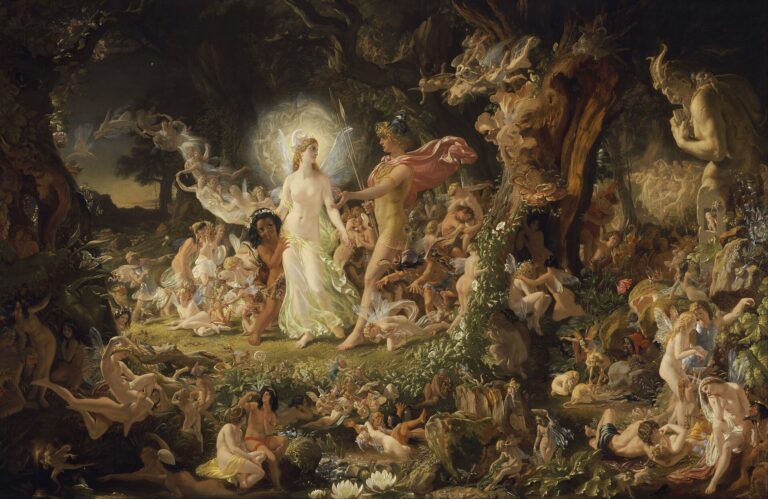
“I am that merry wanderer of the night.” Puck introduces himself in A Midsummer Night’s Dream with a list of his crimes: frightening village girls, skimming the cream off the milk, making the butter refuse to come, misleading travellers at night and laughing at their harm. He is Oberon’s servant and the engine of the whole play. In the Creatures of the Fae deck he is the Jack of Diamonds, the knave of the Seelie Court, and he is a fusion of two much older figures.
The puck, lowercase
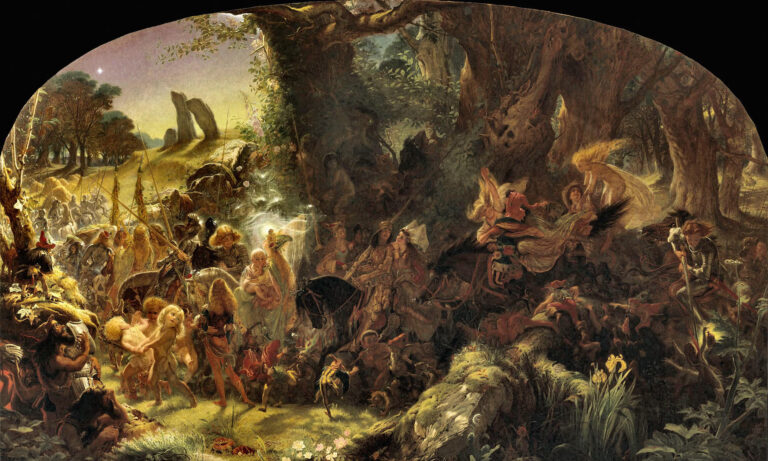
Long before he had a personality, a puck was a kind of creature. The word is Old English, pūca, and it has cousins all over the islands: the Welsh pwca, the Irish púca (the pooka of later folklore), the Cornish bucca, the Old Norse púki. In every case it means something between a goblin and a devil. In Piers Plowman in the fourteenth century, “the pouke” is simply Satan, and the “pouke’s pinfold” is hell. Country people used the word for the mischievous spirit that led you off the path by night, the one that later Devon folk would blame on pixies.
So a puck was not a name. It was a job description.
Robin Goodfellow
The other half of him is Robin Goodfellow, the great English hobgoblin. Robin is the household spirit of the Midlands and the south, the English equivalent of the Scottish brownie: he grinds the malt, sweeps the floor and does a night’s work for a bowl of cream, and he plays tricks on anyone who annoys him. Reginald Scot lists him in The Discoverie of Witchcraft (1584) among the spirits that nurses used to frighten children, alongside bull-beggars, witches, urchins, elves, hags, fairies, satyrs, Pans, fauns, sylvans, Kit-with-the-candlestick, Tom Thumb, hobgoblins and Tom Tumbler. Scot was a sceptic making fun of the whole list, which tells you how familiar the names were.
In 1628 a chapbook appeared called Robin Good-Fellow, His Mad Prankes and Merry Jests, with a woodcut of Robin as a horned, goat-legged figure carrying a broom and a candle, dancing at the head of a ring of fairies. In that version he is the son of Oberon by a mortal woman, which is a tidy way of explaining why he serves the fairy king. Ballads about him circulated with the refrain “Ho, ho, ho!”, which is where Shakespeare got Puck’s laugh.
Shakespeare welds them together
In the Dream, a fairy recognises Oberon’s servant and names him twice over: “Either I mistake your shape and making quite, or else you are that shrewd and knavish sprite called Robin Goodfellow.” Puck answers, “Thou speak’st aright; I am that merry wanderer of the night.” From that scene on, the job description and the hobgoblin are one person, and the name Puck is his alone.
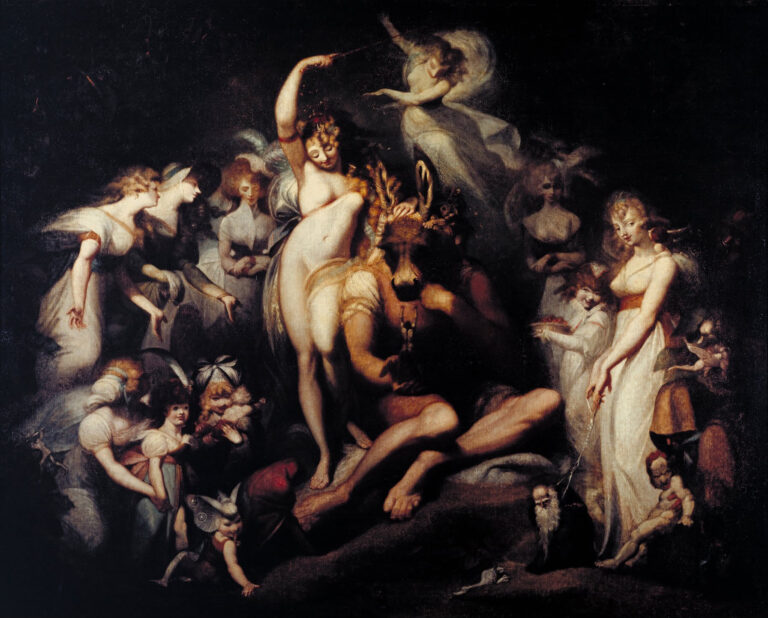
Shakespeare’s Puck is faster, crueller and funnier than Robin ever was. He fetches the love-flower in forty minutes, anoints the wrong lover, gives Bottom an ass’s head for the fun of it, and leads the four Athenians in circles through the wood until they drop. When Oberon is annoyed by the mess, Puck shrugs: “Lord, what fools these mortals be!” And yet he gets the last speech of the play, the apology to the audience. “If we shadows have offended…” The trickster asks forgiveness, and gets it. That too is very Robin Goodfellow.
Puck after Shakespeare
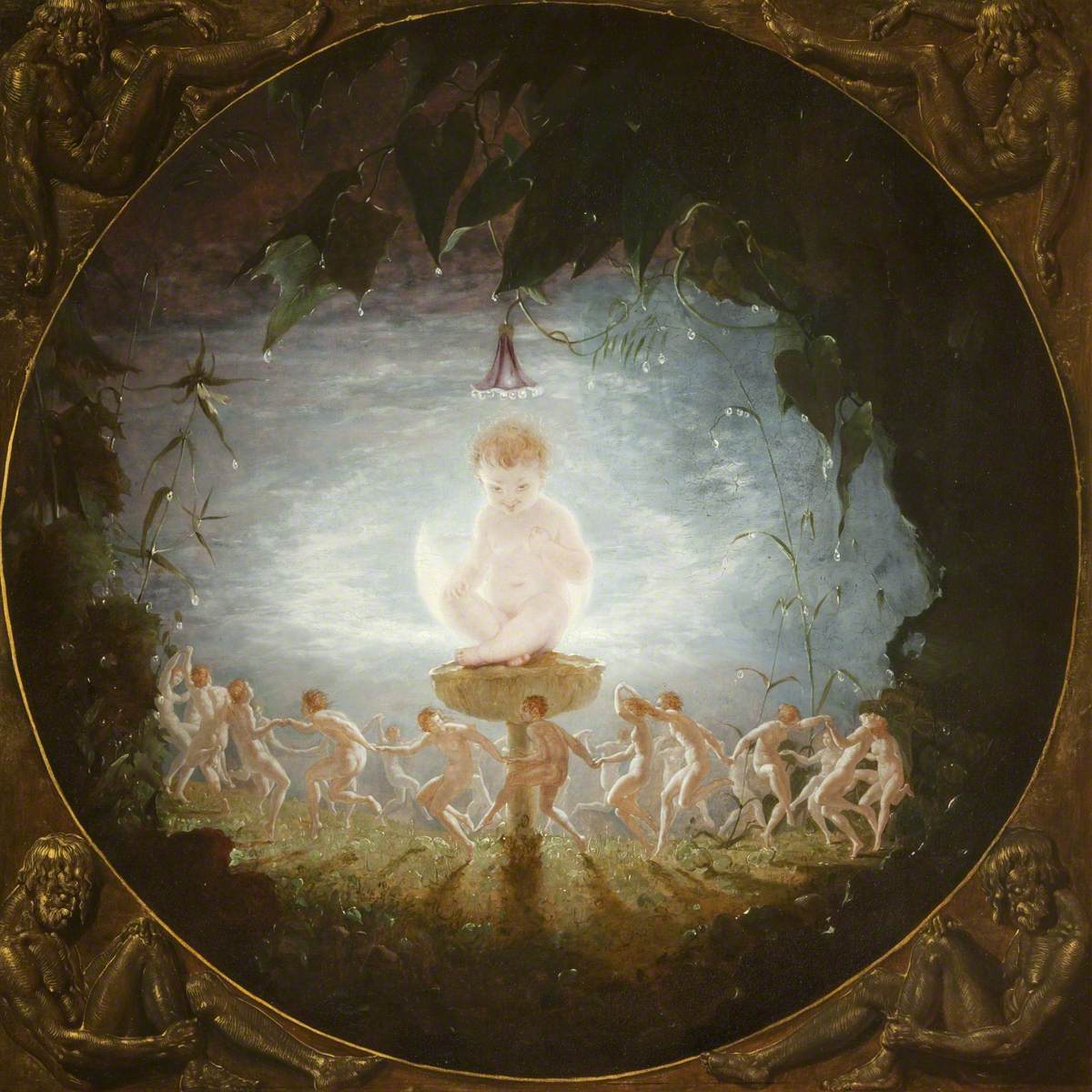
He never went away. Joshua Reynolds painted him as a grinning, chubby child on a toadstool in 1789, and that painting fixed the Victorian idea of him. Richard Dadd’s Puck (1841) is more unsettling. Rudyard Kipling made him the guide to English history in Puck of Pook’s Hill (1906), the last of the People of the Hills, old, kind and sad. Modern fantasy has used him endlessly, from Neil Gaiman’s Sandman to the Gargoyles cartoon.
Why he is a Seelie card
Puck is a trickster, and tricksters are hard to file. The Creatures of the Fae deck puts him with the Seelie Fae for the same reason Shakespeare did: he serves the bright court, his mischief stops short of real harm, and he puts things right in the end. The older hobgoblin was likewise a creature you could live with, as long as you kept the hearth clean and the cream bowl full. Compare him with the Red Cap, the knave of the other side, and the difference between a joke and a murder becomes clear.
On the card
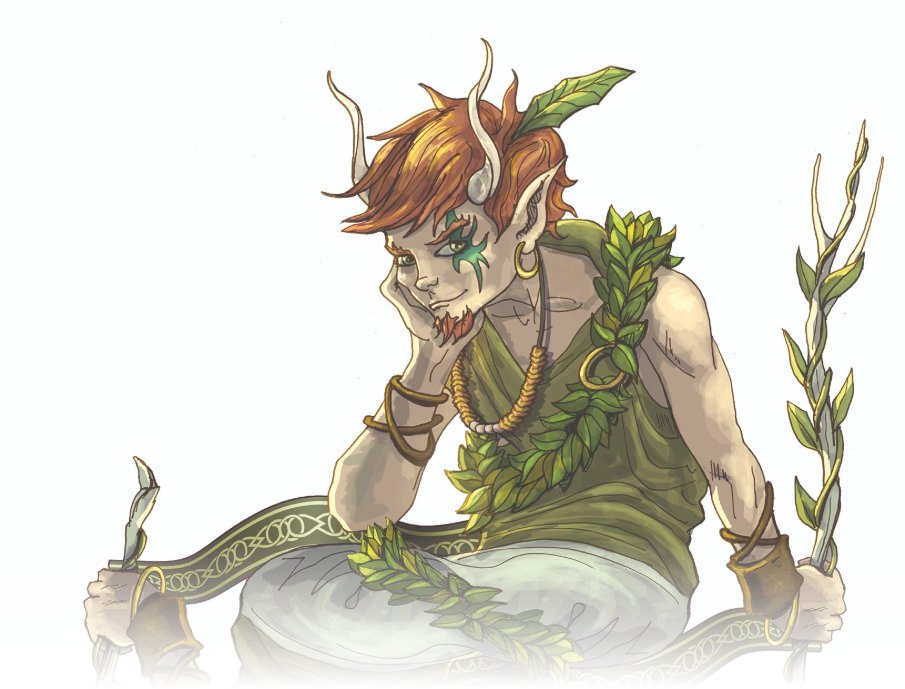
Puck is the Jack of Diamonds, the third of the Shakespearean trio with Oberon and Titania. A jack is the court’s servant and messenger, which is exactly what Puck is. The card also carries his older name, Robin Goodfellow, so that nobody mistakes him for the toddler on the toadstool.
Sources and further reading
- William Shakespeare, A Midsummer Night’s Dream, c. 1595, especially II.i and the epilogue.
- Reginald Scot, The Discoverie of Witchcraft (1584), Book VII, ch. 15.
- Robin Good-Fellow, His Mad Prankes and Merry Jests (1628).
- William Langland, Piers Plowman, for “the pouke”.
- Katharine Briggs, The Anatomy of Puck (1959) and A Dictionary of Fairies (1976), “Puck” and “Robin Goodfellow”.
- Rudyard Kipling, Puck of Pook’s Hill (1906).
The twelve court cards
This post is one of twelve, one for each court card in the Creatures of the Fae deck. The Seelie Fae hold the red suits and the Unseelie Fae the black.
Seelie Fae
- Oberon, King of Diamonds
- Titania, Queen of Diamonds
- Puck, Jack of Diamonds (this post)
- the Brownie, King of Hearts
- the Pixie, Queen of Hearts
- the Leprechaun, Jack of Hearts
Unseelie Fae
- the Erlking, King of Spades
- Queen Mab, Queen of Spades
- Gwyn ap Nudd, Jack of Spades
- the Goblin, King of Clubs
- the Cat Sìth, Queen of Clubs
- the Red Cap, Jack of Clubs
The deck itself, with all twelve court cards, is here on Amazon.
Full disclosure: The Everyday Fae has a connection to the makers of the Creatures of the Fae deck.