Gwyn ap Nudd: The Welsh Lord of the Dead Who Became King of the Faeries
Gwyn ap Nudd is the one figure in the Creatures of the Fae deck who was a god before he was a faery. In medieval Welsh tradition he is the king of the Tylwyth Teg, the Fair Family, and the lord of Annwn, the Otherworld. He rides out with a pack of white, red-eared hounds to gather the souls of the dead. Later Christian writers made him a demon, and later still the folk made him a fairy king. In the deck he is the Jack of Spades, the huntsman of the Unseelie Court, and his story is the deepest in the whole set.
Son of Nudd
The name means something like “White, son of Nudd”, and both halves are old. Gwyn is white, fair, blessed; Nudd is the Welsh form of Nodens, a British god worshipped at a Roman-era temple at Lydney in Gloucestershire, and of the Irish Nuada of the Silver Hand. Gwyn’s brother Edern is an Arthurian knight; his grandfather is Beli Mawr, the ancestor of half the royal lines of Wales. He comes from the top of the mythological tree.
The May Day fight
His great story is in Culhwch and Olwen, the oldest Arthurian tale in Welsh, written down around 1100 from older material. Gwyn abducts the maiden Creiddylad from her betrothed, Gwythyr ap Greidawl. Gwythyr raises an army; Gwyn defeats it and does terrible things to the prisoners, including forcing one man to eat his own father’s heart. Arthur intervenes and imposes a settlement: Creiddylad is to stay in her father’s house, and Gwyn and Gwythyr are to fight for her every May Day until Judgement Day, when whoever wins that last battle shall have her.
The tale adds one more line about Gwyn, and it is the key to him. God, it says, has put the spirit of the demons of Annwn in him, lest this world be destroyed. He is not himself a devil. He is the one strong enough to hold them. That is a very old idea of what a lord of the dead is for.
The May Day fight has been read, reasonably, as a seasonal myth: the king of winter and the king of summer contending each year for the maiden who is the land. Gwyn is the winter king. If you want to know why he is an Unseelie card, that is why.
The hunter and his hounds
In a poem in the Black Book of Carmarthen, copied around 1250 but older in substance, Gwyn speaks for himself. A hero named Gwyddno Garanhir meets him on the road and asks who he is. Gwyn answers that he comes from battle, that he has been where the warriors of Britain fell, and he names the places one by one. He describes his horse and his hound: “Dormach, who was Maelgwn’s”, with the red nose. And he says that he is a companion of the dead. It is the first appearance in literature of the Wild Hunt in Wales.
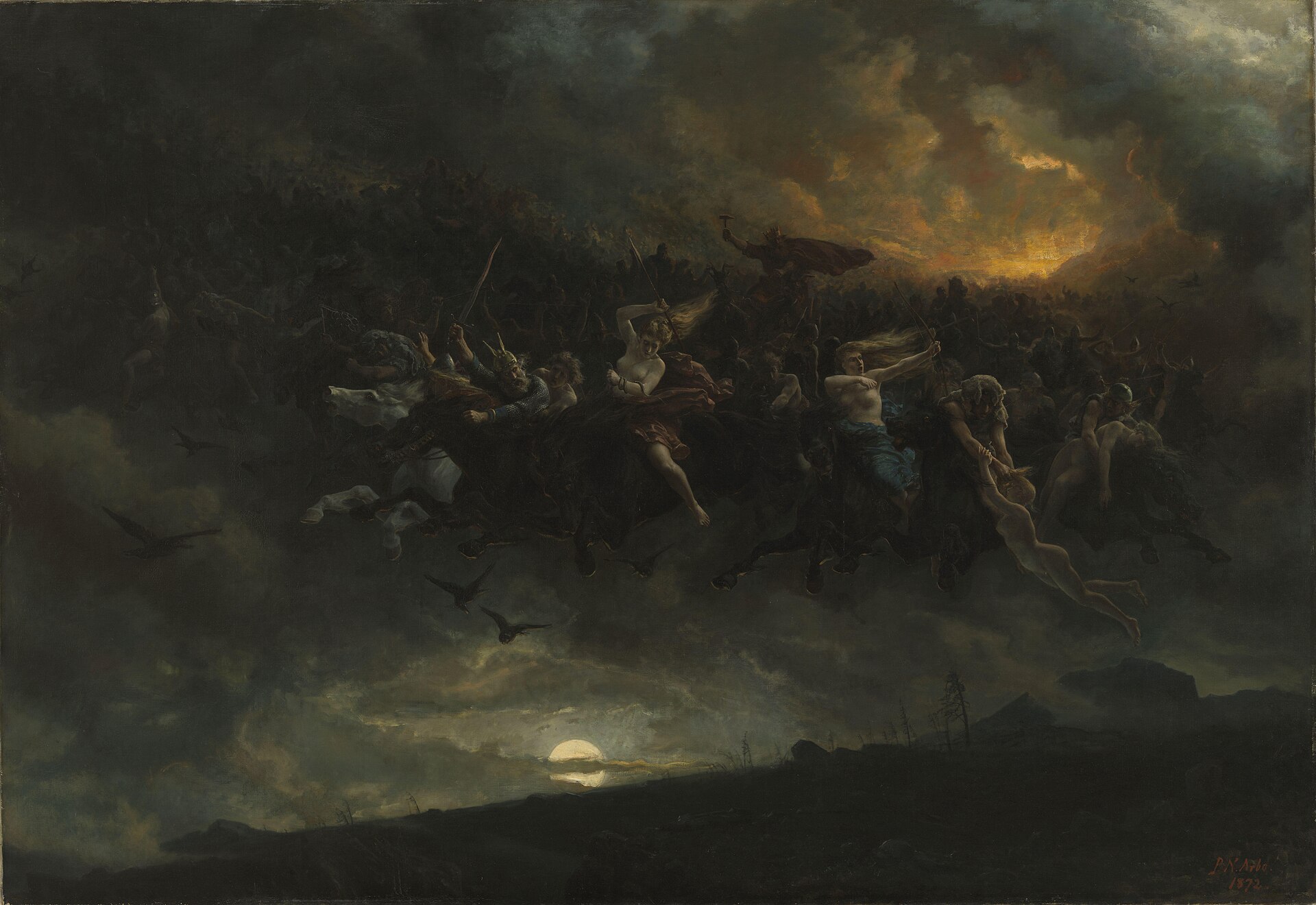
The hounds are the Cŵn Annwn, the hounds of the Otherworld, white with red ears, whose baying is loud when far off and soft when close. In later Welsh folklore they are heard in the sky on autumn nights, hunting souls, and the man who hears them should get indoors. Gwyn rides at their head, and in some tellings his huntsman Iolo ap Huw drives them over Cadair Idris every Halloween. A fourteenth-century Latin tract against divination complains that Welsh soothsayers still called on “Gwyn ap Nudd, king of Annwn” before going into the woods. The old god was taking a long time to leave.
Gwyn and the saint
The best story about him is also the one that explains what happened to him. In the Life of St Collen, written down in the sixteenth century from older tradition, the saint is living as a hermit on Glastonbury Tor when he hears two men below talking about Gwyn ap Nudd, king of Annwn and of the fairies. Collen shouts down that they are devils. A messenger arrives inviting him to dine with the king on the top of the Tor. Collen refuses twice, goes the third time, and takes a flask of holy water under his robe.
On the summit he finds a splendid castle, music, horses, beautiful youths and maidens, and the king on a golden chair, whose retinue wear red on one side and blue on the other. Gwyn offers him the finest food. Collen says he does not eat the leaves of trees. Gwyn asks whether he has ever seen men better dressed. Collen says the red is the burning and the blue is the cold, meaning hell. Then he throws the holy water, and castle, court, music and king vanish, and he is alone on the green hill.
That is the moment the lord of the dead became a fairy. The saint had won, officially. Unofficially, Glastonbury Tor has been Gwyn’s hill ever since, and people still say so.
Why he is the Jack of Spades
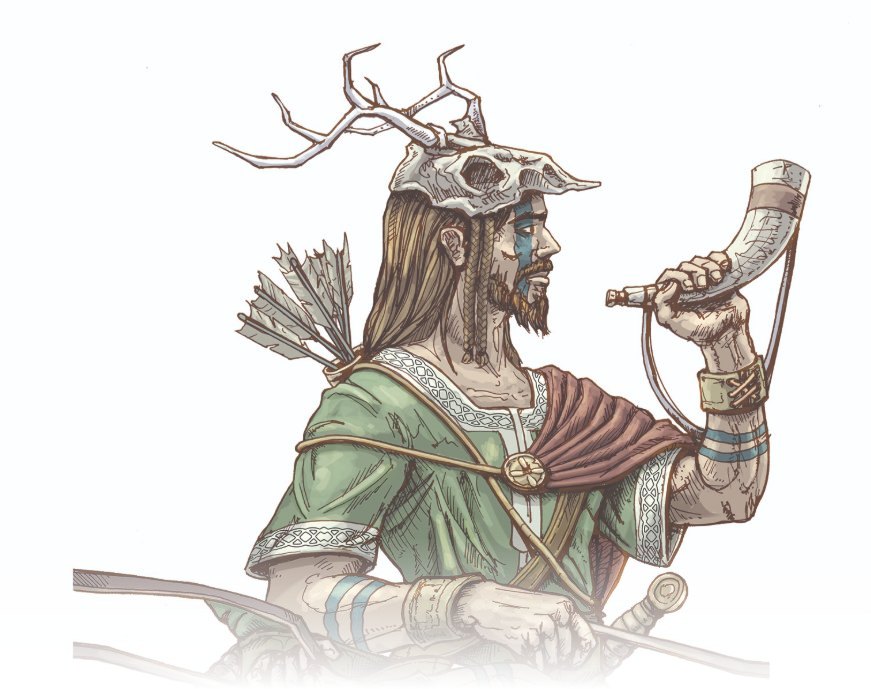
In Welsh tradition Gwyn is a king, and a case could be made for giving him the crown of the suit. The deck gives it to the Erlking, the dark king of the German and Scandinavian tradition, and makes Gwyn the jack, and I think that is right for the card rather than the man. The jack is the mounted figure of the court, the knight, the one who rides out while the king sits. Gwyn is the rider. He is the leader of the Hunt, the companion of the dead who goes to fetch them, and the Spades suit needed a huntsman more than it needed a second king. With Mab as its queen, the Spades court is the court of the night ride, and Gwyn is the one in the saddle.
Sources and further reading
- Culhwch and Olwen, c. 1100, in Sioned Davies (trans.), The Mabinogion (2007).
- “The Dialogue of Gwyn ap Nudd and Gwyddno Garanhir”, Black Book of Carmarthen, c. 1250.
- Buchedd Collen (The Life of St Collen), 16th-century manuscript; translated in Lady Charlotte Guest’s notes to The Mabinogion (1849).
- Speculum Christiani, 14th century, on Welsh invocations of Gwyn.
- Rachel Bromwich, Trioedd Ynys Prydein (3rd ed., 2006), notes on Gwyn ap Nudd.
- John Rhŷs, Celtic Folklore: Welsh and Manx (1901), on the Cŵn Annwn and the Tylwyth Teg.
The twelve court cards
This post is one of twelve, one for each court card in the Creatures of the Fae deck. The Seelie Fae hold the red suits and the Unseelie Fae the black.
Seelie Fae
- Oberon, King of Diamonds
- Titania, Queen of Diamonds
- Puck, Jack of Diamonds
- the Brownie, King of Hearts
- the Pixie, Queen of Hearts
- the Leprechaun, Jack of Hearts
Unseelie Fae
- the Erlking, King of Spades
- Queen Mab, Queen of Spades
- Gwyn ap Nudd, Jack of Spades (this post)
- the Goblin, King of Clubs
- the Cat Sìth, Queen of Clubs
- the Red Cap, Jack of Clubs
The deck itself, with all twelve court cards, is here on Amazon.
Full disclosure: The Everyday Fae has a connection to the makers of the Creatures of the Fae deck.