Goblins: From a Demon at Évreux to the King Under the Mountain
Every language in Europe has a word for the small, ugly, grasping creature that lives underground and means you no good. English settled on goblin, and the Creatures of the Fae deck makes a goblin the King of Clubs, the ruler of the earthy, wooded, underhill half of the Unseelie Court. He is the one card in the twelve that stands for a whole species rather than a single character, and that is deliberate. Goblins have never had a king worth naming. They have had a crowd.
The word
Goblin arrives in English from Old French gobelin, and the French had it from somewhere earlier. The first recorded goblin is a specific demon. Around 1140 the Norman chronicler Orderic Vitalis wrote that the people of Évreux called a troublesome spirit Gobelinus, and that St Taurinus had cast it out of a temple of Diana centuries before; the name, he says, was still in local use. Where the French got gobelin is argued over. The German kobold is a cousin, and both may go back to the Greek kobalos, a rogue or a knavish spirit, which would make the goblin one of the oldest tricksters in the Western vocabulary.
In English the word quickly stopped meaning one demon and started meaning a kind. By the fourteenth century a goblin was any malicious or mischievous sprite, and by the sixteenth there were hobgoblins too: hob is a familiar form of Robin, and a hobgoblin is a goblin you can live with, a Robin Goodfellow. Shakespeare uses the words that way, and so did everyone after him until Tolkien decided hobgoblins should be the bigger, nastier sort.
Goblins underground
The goblin’s natural home is the mine. Miners across Europe believed in small spirits who lived in the rock, knocked on the walls to show where the ore was, or to warn of a collapse, and punished anyone who whistled, swore or failed to leave them a crust. In Cornwall they were the knockers; in Wales the coblynau, which is the Welsh form of goblin; in Germany the kobolds and the Bergmännlein. The German miners thought the kobolds also spoiled the ore out of spite, and when they found a troublesome silvery mineral that would not smelt properly they named it after the spirits. We still call it cobalt.
So the oldest goblin is not a monster at all. He is a miner’s neighbour, dangerous if offended, useful if fed, a thoroughly Unseelie arrangement.
Goblins in the books
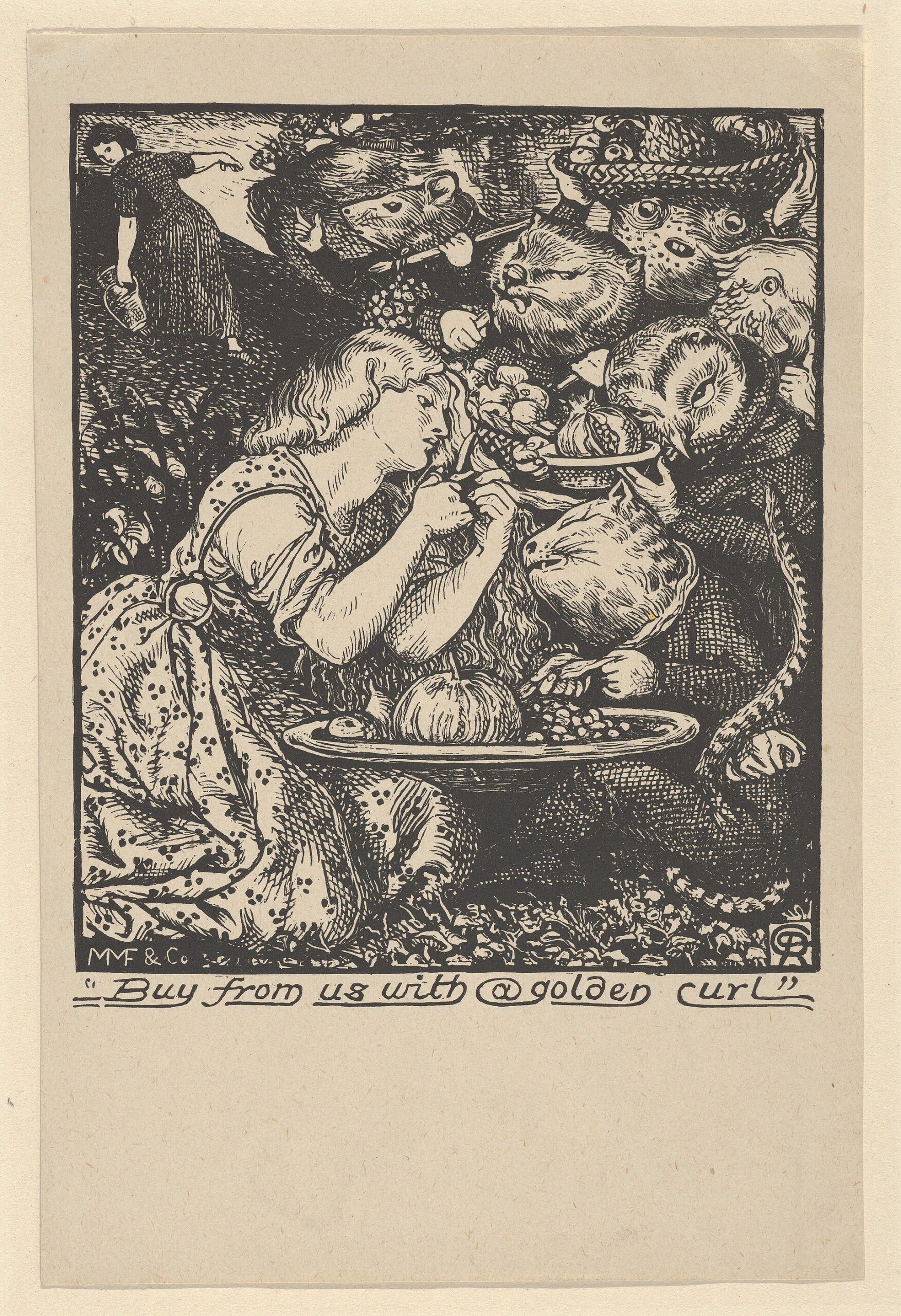
The goblin as we picture him, green or grey, long-nosed, in a horde, is a creation of the nineteenth century, and two books did most of the work. Christina Rossetti’s Goblin Market (1862) gives us the goblin merchants with their animal faces, cat-faced and rat-paced and snail-paced, crying their forbidden fruit to the sisters Laura and Lizzie. It is one of the strangest and best poems in English and it is built entirely on the old rule against eating faery food. George MacDonald’s The Princess and the Goblin (1872) supplies the rest: a goblin kingdom under the mountain, a goblin king and queen, soft-footed creatures with hard heads who cannot bear singing, and a plot to tunnel up into the human castle. Tolkien read MacDonald as a boy and his goblins in The Hobbit (1937) are MacDonald’s goblins with better weapons; in The Lord of the Rings he renamed them orcs, and the word goblin has never fully recovered its independence.
And then there is the goblin king everyone under sixty pictures first: Jareth, in Labyrinth (1986), designed by Brian Froud and played by David Bowie. Froud’s goblins in that film are the truest to the old tradition, grubby, numerous, squabbling and not very bright, and his king is the only one who has ever been glamorous. The Creatures of the Fae king is not Jareth. But he is a king of that crowd.
Why the King of Clubs
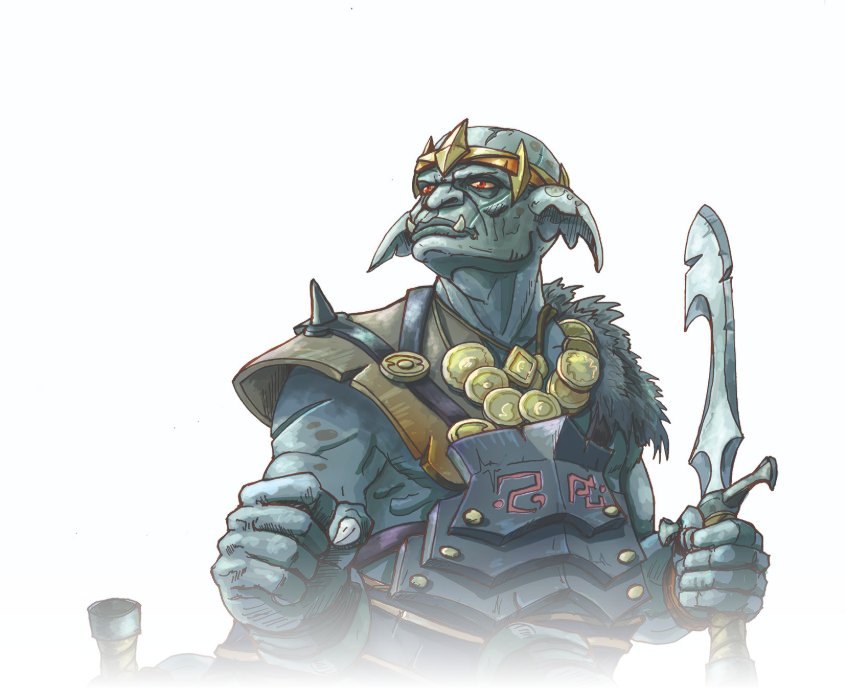
Clubs is the suit of the staff, the cudgel and the wood, which is to say the suit of the earth and what grows and burrows in it. In the Creatures of the Fae deck the Clubs court is the Unseelie Court outdoors and underground: the goblin as king, the Cat Sìth as queen, the Red Cap as jack. Where the Spades rule the Otherworld, the Clubs rule the dark corners of this one: the mine, the moor, the ruined tower. A goblin king belongs underground with a weapon in his hand, and the card obliges.
Sources and further reading
- Orderic Vitalis, Historia Ecclesiastica, Book V, c. 1140, on Gobelinus at Évreux.
- Oxford English Dictionary, “goblin”, “hobgoblin”.
- Georgius Agricola, De Re Metallica (1556) and De Animantibus Subterraneis (1549), on mine spirits.
- Christina Rossetti, Goblin Market (1862).
- George MacDonald, The Princess and the Goblin (1872).
- Katharine Briggs, A Dictionary of Fairies (1976), “Goblins”, “Knockers”, “Coblynau”.
The twelve court cards
This post is one of twelve, one for each court card in the Creatures of the Fae deck. The Seelie Fae hold the red suits and the Unseelie Fae the black.
Seelie Fae
- Oberon, King of Diamonds
- Titania, Queen of Diamonds
- Puck, Jack of Diamonds
- the Brownie, King of Hearts
- the Pixie, Queen of Hearts
- the Leprechaun, Jack of Hearts
Unseelie Fae
- the Erlking, King of Spades
- Queen Mab, Queen of Spades
- Gwyn ap Nudd, Jack of Spades
- the Goblin, King of Clubs (this post)
- the Cat Sìth, Queen of Clubs
- the Red Cap, Jack of Clubs
The deck itself, with all twelve court cards, is here on Amazon.
Full disclosure: The Everyday Fae has a connection to the makers of the Creatures of the Fae deck.