The Leprechaun Before the Cereal Box: Ireland’s Solitary Shoemaker
The leprechaun has the worst public relations of any creature in these twelve posts. He has been on cereal boxes, in parades and on the side of a basketball court for so long that it is hard to see the small, bad-tempered shoemaker underneath. He is there, though, and he is older than almost anything else in the deck. In the Creatures of the Fae deck he is the Jack of Hearts, the knave of the working Seelie suit, and he has earned it.
A very old word
The Irish name is leipreachán, and in its oldest form, luchorpán, it is already in a text of the eighth century. The usual reading is lú, small, and corp, body: the small-bodied one. The later folk etymology that made him leith bhrógan, the one-shoe-maker, is charming and almost certainly backwards; the shoemaking came from the name, not the name from the shoemaking.
That eighth-century text is the Echtra Fergusa maic Léti, the Adventure of Fergus son of Léti, and the luchorpáin in it are not cobblers at all. They are water-sprites who find King Fergus asleep on the shore and try to carry him into the sea. He wakes as his feet touch the water, catches three of them, and makes them grant him a wish in exchange for their lives: the power to travel under water. It is a bargaining story, the oldest leprechaun bargaining story, and the pattern never changes afterwards. Catch him, hold him, make him pay.
The shoemaker and his gold
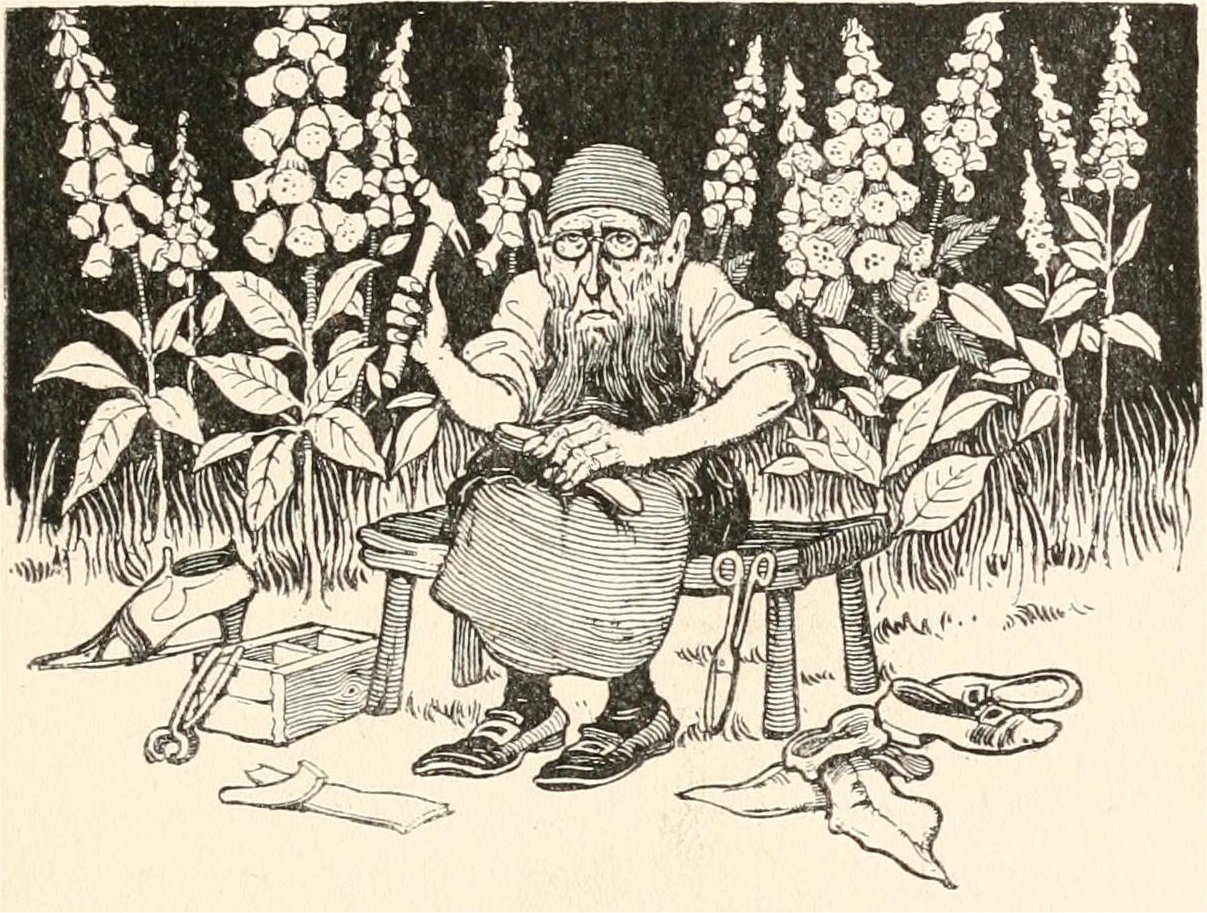
By the time the folklorists arrived in the nineteenth century, the leprechaun had settled into the figure we half know. He is small, old, solitary and ill-natured. He is a cobbler, and you find him by the tap-tap of his hammer, usually working on a single shoe. He has a crock of gold hidden somewhere, and if you can catch him and keep your eyes on him he must tell you where it is. The moment you look away he is gone, and he will do anything to make you look away.
Thomas Crofton Croker’s Fairy Legends and Traditions of the South of Ireland (1825) has the classic version, “The Field of Boliauns”, under the name cluricaune. Tom Fitzpatrick catches the little cobbler, forces him to point out the ragwort stalk under which the gold is buried, ties his red garter around it, and runs home for a spade. When he comes back, every ragwort in the field is wearing a red garter. It has been retold ever since.
W. B. Yeats, collecting in 1888, put the leprechaun among the “solitary fairies”, as opposed to the trooping kind who dance and ride together, and quoted a description from the American writer D. R. McAnally of a figure in a red jacket with seven rows of seven buttons. Red, not green. The green suit, the buckled hat and the shamrock are twentieth-century American inventions, the result of St Patrick’s Day, Hollywood and a breakfast cereal. The rainbow is newer still. No Irish storyteller before 1900 would have recognised any of it.
Cluricaune and fear dearg
The leprechaun has two close relatives who are sometimes the same creature and sometimes not. The cluricaune is a leprechaun who has taken to drink, haunting cellars and riding sheep and dogs for sport at night. The fear dearg, the red man, is a leprechaun who has taken to practical jokes of a nastier kind and is best treated with elaborate politeness. Yeats thought all three were one species in different moods. Croker was not so sure. I incline to Yeats.
Why he is a Seelie card
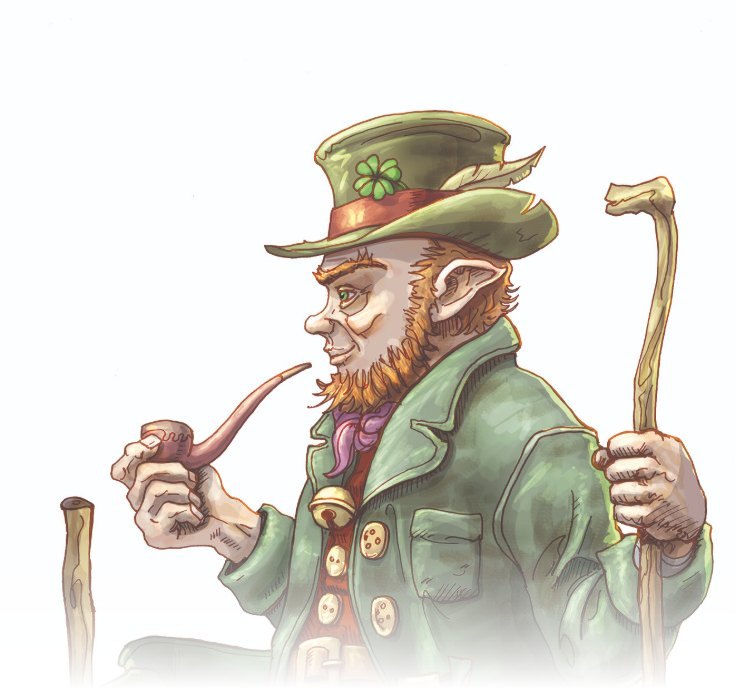
This needs a word, because the leprechaun is not nice. He is a cheat, a miser and a trickster, and in the stories he nearly always wins. But he does not harm anyone. Nobody is stolen, nobody wastes away, nobody dies; the man with the garter goes home poorer in dignity and nothing else. The leprechaun belongs with the Seelie Fae for the same reason Puck does: his mischief has a floor under it. He is also a craftsman, and in the Creatures of the Fae deck the Hearts court is the court of work, with the brownie as king, the pixie as queen, and the cobbler as the knave who keeps everyone shod.
A jack is the servant of the court and the one most likely to be up to something. There was never any question which card he was.
Sources and further reading
- Echtra Fergusa maic Léti, 8th century; edited and translated by D. A. Binchy in Ériu 16 (1952).
- Thomas Crofton Croker, Fairy Legends and Traditions of the South of Ireland (1825), “The Field of Boliauns”.
- W. B. Yeats (ed.), Fairy and Folk Tales of the Irish Peasantry (1888), “The Solitary Fairies”.
- D. R. McAnally, Irish Wonders (1888).
- Katharine Briggs, A Dictionary of Fairies (1976), “Leprechaun”, “Cluricaune”, “Fir Darrig”.
The twelve court cards
This post is one of twelve, one for each court card in the Creatures of the Fae deck. The Seelie Fae hold the red suits and the Unseelie Fae the black.
Seelie Fae
- Oberon, King of Diamonds
- Titania, Queen of Diamonds
- Puck, Jack of Diamonds
- the Brownie, King of Hearts
- the Pixie, Queen of Hearts
- the Leprechaun, Jack of Hearts (this post)
Unseelie Fae
- the Erlking, King of Spades
- Queen Mab, Queen of Spades
- Gwyn ap Nudd, Jack of Spades
- the Goblin, King of Clubs
- the Cat Sìth, Queen of Clubs
- the Red Cap, Jack of Clubs
The deck itself, with all twelve court cards, is here on Amazon.
Full disclosure: The Everyday Fae has a connection to the makers of the Creatures of the Fae deck.