Oberon, King of the Faeries: From Dwarf King to Shakespeare’s Monarch
Every faery court needs a king, and for the last four hundred years the English-speaking world has had one: Oberon, lord of the fairies, husband of Titania, master of Puck. He is the King of Diamonds in the Creatures of the Fae deck and the head of its Seelie Court. He is also a good deal older and stranger than the figure most of us met in school.
Before Shakespeare
Oberon’s name is German before it is English. Alberich, “elf-ruler”, is the dwarf who guards the Nibelung treasure in the Nibelungenlied (around 1200) and who appears, under the same name, in several other German heroic poems. When the French borrowed him he became Auberon, and in the thirteenth-century chanson de geste Huon de Bordeaux he is a dwarf king of the fairies, three feet tall and beautiful of face, the son of Julius Caesar and the fairy Morgan le Fay. He carries a magic horn that makes everyone who hears it dance, and he owns a cup that fills itself with wine for the virtuous and stays empty for the wicked.
That Auberon is already recognisable. He is capricious, generous to those he favours and dangerous to those who cross him. He helps the hero Huon on an impossible quest, but only after Huon swears a set of conditions, and he withdraws his help the moment one is broken. If you have read the old rules for dealing with the fae, you will recognise the pattern.
Lord Berners translated Huon into English around 1534, and the dwarf king arrived in England with the spelling Oberon. Edmund Spenser gave him a cameo in The Faerie Queene (1590) as the father of Gloriana, the fairy queen who stands for Elizabeth I. Robert Greene put him on stage in The Scottish History of James IV a few years before Shakespeare did.
The Oberon everyone knows
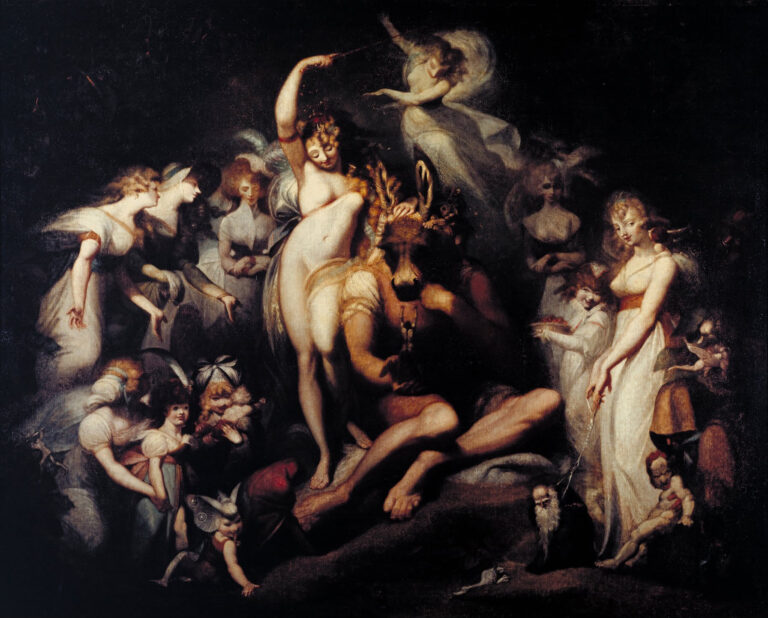
A Midsummer Night’s Dream (around 1595) made Oberon permanent. Shakespeare’s king is no longer a dwarf. He is a jealous, scheming, ultimately forgiving monarch who is feuding with his queen over a human child, the changeling boy Titania refuses to give up. Their quarrel has thrown the seasons out of joint; Titania says the spring, summer, autumn and winter have changed their liveries, and “this same progeny of evils comes from our debate, from our dissension”.
Oberon’s answer is the flower called love-in-idleness, whose juice makes the sleeper dote on the first creature they see. He has Puck squeeze it on Titania’s eyes, and on the eyes of the wrong Athenian, and the comedy follows. At the end he lifts the spell, takes the boy, reconciles with his queen and blesses the house of Theseus. The last word of the play is his court’s, not the Duke’s.
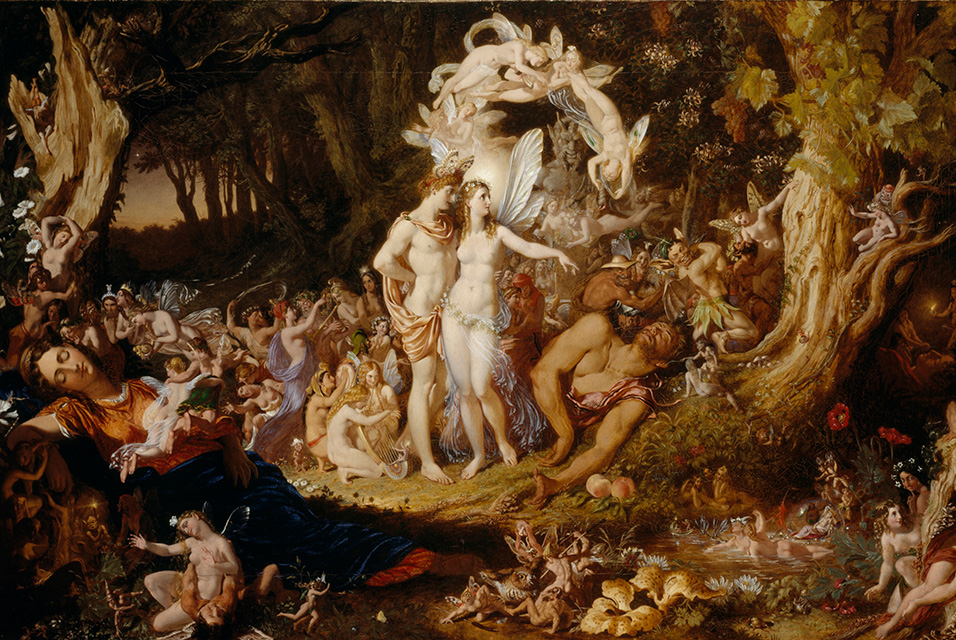
It is a flattering portrait of faery kingship, and it has stuck. Ben Jonson wrote a masque, Oberon, the Faery Prince, for Prince Henry in 1611. Carl Maria von Weber built an opera on Huon in 1826 and called it Oberon. The Victorian fairy painters could not leave him alone: Joseph Noel Paton’s The Quarrel of Oberon and Titania (1849) and its companion The Reconciliation are the best known. William Herschel’s son John named a moon of Uranus after him in 1852, and all of that planet’s moons have carried Shakespearean names since.
What kind of king is he?
Not a tame one. Even in Shakespeare, Oberon gets his way by enchantment and a certain amount of cruelty; the trick he plays on Titania is humiliating and he knows it. In the older Huon he is quicker to anger still. Folklorists have pointed out that the “fairy king” of actual British and Irish tradition is a shadowy figure beside the fairy queen, who does most of the abducting and bargaining in the ballads. Oberon is a literary king more than a folk one.
But he is a Seelie king in the proper sense. The Seelie Court, in the Scottish distinction I’ve written about elsewhere, was the court that could be dealt with: proud, easily offended, but bound by honour and capable of blessing as well as harm. Oberon’s final act in the Dream, walking through the sleeping house to bless its beds, is the Seelie Court at its best.
On the card
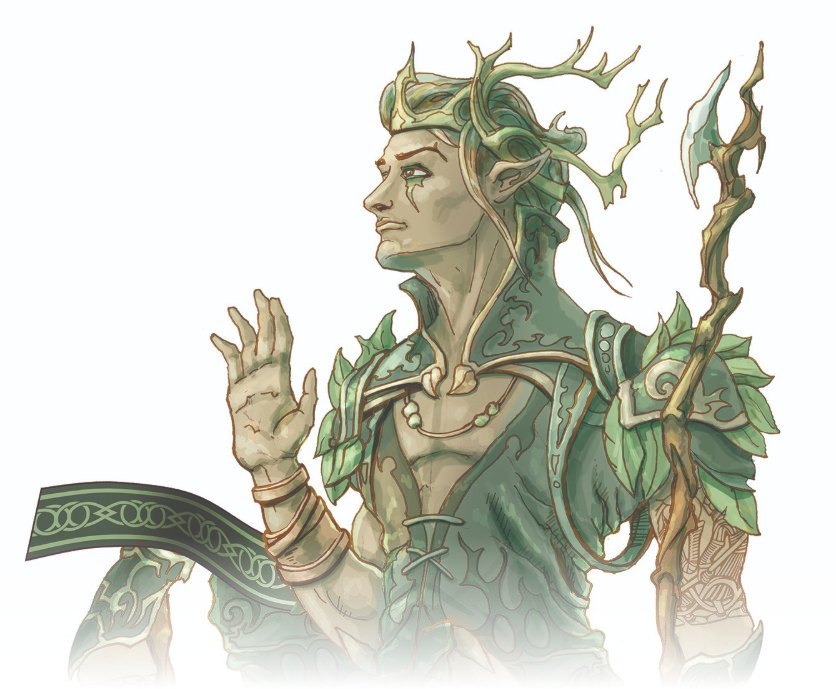
In the Creatures of the Fae deck, Oberon is the King of Diamonds, the first card of the Seelie Fae and the head of the Shakespearean suit. Titania is his queen and Puck his jack, which is how the three of them have travelled together since 1595. Diamonds is a fitting suit for him: in most of the old card games it is the suit of wealth and light, and Oberon is a king of a bright court, even when he is sulking.
Sources and further reading
- Huon de Bordeaux, 13th century; English translation by John Bourchier, Lord Berners, c. 1534.
- William Shakespeare, A Midsummer Night’s Dream, c. 1595.
- Edmund Spenser, The Faerie Queene, Book II, canto x (1590).
- Ben Jonson, Oberon, the Faery Prince (1611).
- Katharine Briggs, A Dictionary of Fairies (1976), “Oberon”.
- Katharine Briggs, The Anatomy of Puck (1959), on the fairies of Elizabethan literature.
The twelve court cards
This post is one of twelve, one for each court card in the Creatures of the Fae deck. The Seelie Fae hold the red suits and the Unseelie Fae the black.
Seelie Fae
- Oberon, King of Diamonds (this post)
- Titania, Queen of Diamonds
- Puck, Jack of Diamonds
- the Brownie, King of Hearts
- the Pixie, Queen of Hearts
- the Leprechaun, Jack of Hearts
Unseelie Fae
- the Erlking, King of Spades
- Queen Mab, Queen of Spades
- Gwyn ap Nudd, Jack of Spades
- the Goblin, King of Clubs
- the Cat Sìth, Queen of Clubs
- the Red Cap, Jack of Clubs
The deck itself, with all twelve court cards, is here on Amazon.
Full disclosure: The Everyday Fae has a connection to the makers of the Creatures of the Fae deck.